Authors
Authors

Benedikt Corkill
As international markets continue to grapple with the imperatives of climate change and sustainable development, pressure is mounting for regulatory responses to drive action. At the heart of this global trend is the surge in a broad range of sustainability-related regulatory changes – from transparency, reporting and supply chain due diligence requirements, to imposing direct financial costs aimed at pricing compliance and encouraging behavior that fosters an environmentally and socially sustainable global market.
Environment and sustainability
The long arm of EU law
Possibly the most significant regulatory advances are being made by the EU with its command-and-control approach to ESG issues. The EU’s Green Deal is casting a wide net that stretches beyond its borders. Recent initiatives range from the market mechanisms CBAM and the EU ETS for pricing carbon, to the CSRD’s disclosure and transparency changes to the Accounting Directive, as well as requirements for supply chain due diligence under the CSDDD and the Forced Labour Regulation, to name just a few. Layered onto this are quantitative changes under FuelEU for maritime shipping emissions, ReFuelEU for aviation, the Renewable Energy Directive and wider environmental initiatives under the EU’s ‘Fit for 55’ scheme.
The cumulative effect of the EU’s various ESG and sustainability laws is to set a new benchmark for regulating the conduct of companies within and outside the EU to gain or maintain EU market access and harmonize standards. Many governments around the world are looking to adopt the EU’s drive for regulatory controls, seizing the opportunity to regulate sustainability while supporting clean technology development and building in-country capacity to future-proof certain sectors. What does this all mean for the transportation sector?
The transportation sector is likely to find itself deeper in the eye of the regulatory storm. The “long arm” effect of EU laws is reaching through the entire length of supply chains, extending the EU’s extraterritorial reach and catching the transportation sector.
The EU Green Deal is significantly impacting the sector through its focus on global supply chains by promoting sustainability, transparency and innovation. Its influence is driving other countries to adopt similar regulations, creating a ripple effect that aims to encourage responsible business practices worldwide.
Stakeholders are also demanding deeper and more transparent disclosure of corporate engagement when evaluating, monitoring and addressing environmental and social risks and impact management. This is creating a complex regulatory landscape where participants in the transportation sector must navigate multiple overlapping frameworks. As an integral part of the complex and interlinked global supply chain, facilitating global trade means that the transportation sector must secure and maintain both the environmental and social licenses needed to operate.
This does also presents opportunities - for advancements in technologies, upgrading transportation infrastructure and innovating solutions to future-proof (and climate-proof) the sector. Sustainable aviation fuels, electrification of ground transportation, upgrading maritime vessels and port infrastructure, low-carbon corridors and using AI for efficiencies are facilitating positive contributions the transportation sector can make for environmental and social sustainability.
Horizon scanning
Global regulations are trending toward greater transparency in supply chains, driving the disclosure of environmental and social data and influencing the transportation sector’s role in technological and operational changes for sustainable development. The reach of the EU’s ESG legal framework is evident in the legislative responses emerging from non-EU countries. Figure 1 below demonstrates the global reach of the long arm of EU law, extending to supply chain due diligence regulations being proposed or adopted around the world. It remains to be seen how this influence will change with the new U.S. administration.
Figure 1
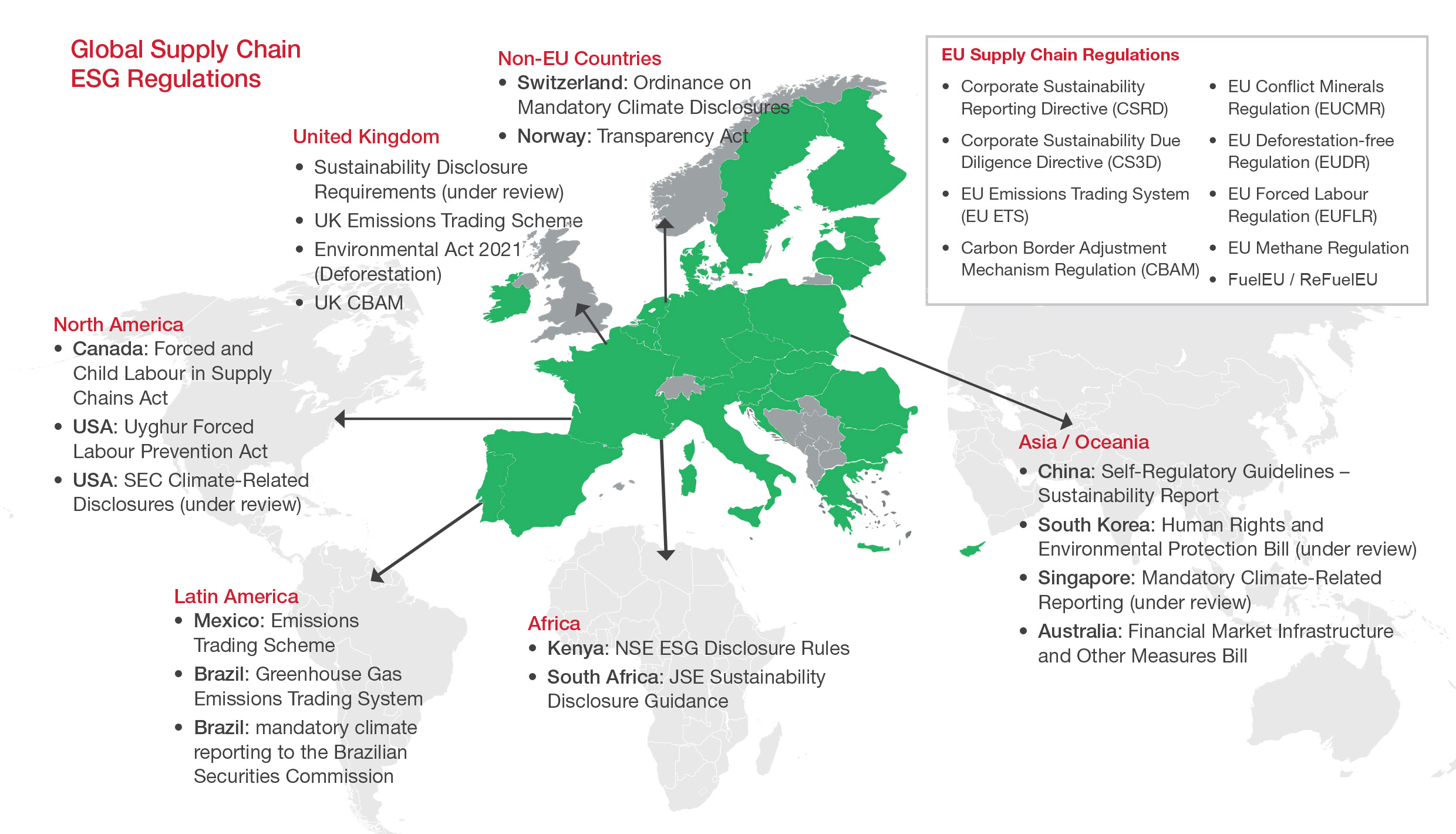
This map shows some of the global supply chain ESG regulations similar to the EU Green Deal by country/jurisdiction and here is a summary of the map:
- Africa
- Kenya: NSE ESG Disclosure Rules
- South Africa: JSE Sustainability Disclosure Guidance
- Asia/Oceania
- China: Self-Regulatory Guidelines – Sustainability Report
- South Korea: Human Rights and Environmental Protection Bill (under review)
- Singapore: Mandatory Climate-Related Reporting (under review)
- Australia: Financial Market Infrastructure and Other Measures Bill
- EU
- Corporate Sustainability Reporting Directive (CSRD)
- Corporate Sustainability Due Diligence Directive (CS3D)
- EU Emissions Trading System (EU ETS)
- Carbon Border Adjustment Mechanism Regulation (EU CBAM)
- EU Conflict Minerals Regulation (EUCMR)
- EU Deforestation-free Regulation (EUDR)
- EU Forced Labour Regulation (EUFLR)
- EU Methane Regulation
- FuelEU/ReFuelEU
- Latin America
- Mexico: Emissions Trading Scheme
- Brazil: Greenhouse Gas Emissions Trading System
- Brazil: mandatory climate reporting to the Brazilian Securities Commission
- Non-EU countries
- Switzerland: Ordinance on Mandatory Climate Disclosures
- Norway: Transparency Act
- North America
- Canada: Forced and Child Labour in Supply Chains Act
- USA: Uyghur Forced Labour Prevention Act
- USA: SEC Climate-Related Disclosures (under review)
- United Kingdom
- Sustainability Disclosure Requirements (under review)
- UK Emissions Trading Scheme
- Environmental Act 2021 (Deforestation)
- UK CBAM
Authors
Authors
Benedikt Corkill