Authors


The generational NBA star’s ability to defy metrics and break algorithms exposes their inherent limitations in other contexts
Nikola Jokić is a six-foot-eleven, 284-pound Serbian National Basketball Association superstar who plays center for the Denver Nuggets, an American professional basketball team. Jokić is an NBA champion, an NBA Finals Most Valuable Player, a three-time NBA MVP, an eight-time NBA All-Star, a five-time All-NBA First Team selection, and the recipient of numerous additional accolades throughout his career. He is widely regarded as one of the three premier players of the past decade, if not the top, and is considered among the greatest centers in the history of the NBA.
He’s also a completely unexpected analytical anomaly. Jokić was a player whom no person or algorithm saw coming in an era of analytics. Selected a lowly forty-first overall in the 2014 NBA Draft, a selection famously made during a Taco Bell commercial, Jokić was overlooked by every predictive model in existence. No scouting algorithm or machine learning system identified the “slightly overweight” Serbian teenager, who fans say looks like he plays “in flip-flops”, as a future first-ballot Hall of Famer.
Professional basketball represents one of the most statistically saturated environments. Artificial intelligence (AI) systems now measure 29 different data points per player, 60 times per second, to analyze spatial, physical, and tactical elements of the game in real time.[1] Shot difficulty, player contributions, physical movement metrics, team strategies, and tendencies are all factors that AI machines process to evaluate performance. Points, assists, rebounds, steals, blocks, shooting percentages, plus-minus ratings, player efficiency ratings, and other advanced metrics are tracked and analyzed. Therefore, if there ever was a domain where AI should excel at capturing value, it would be the NBA.
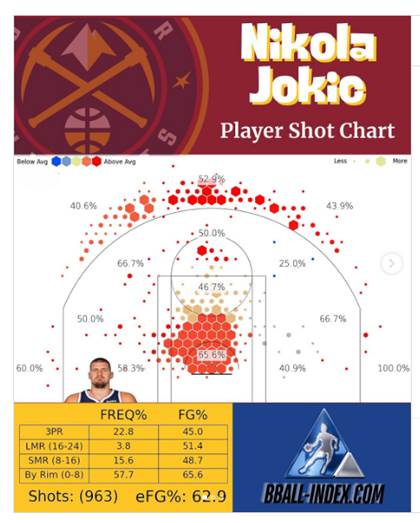
Yet, AI still cannot comprehend a player like Jokić. Jokić remains a mystery due to his improvisational creativity, unconventional play style, and the ability to execute the unexpected. Jokić’s greatness exposes the fundamental limitations of AI: the statistical models failed not because they lacked data, but because Jokić’s value transcends what data can capture. While AI can calculate arc, speed, trajectory, and angles in a basketball game, no AI data point can capture the natural and innate talent with which Jokić plays. It’s not hyperbolic to say he is unquantifiable by literal fact. This is the paradox at the heart of the human versus machine debate. The qualities that make someone exceptional are the same qualities that defy algorithmic prediction. Jokić’s greatness is unquantifiable because he goes against the grain of predictability, and nothing in sports is more valuable than the human element of immeasurable greatness.
The Jokić phenomenon may carry implications for lawyers and their clients as they navigate an increasingly AI-saturated professional landscape. As the use of AI platforms increases and clients demand greater efficiency, the temptation to rely on AI tools grows. AI promises to enhance the practice of law, yet the Jokić case study serves as a compelling reminder that even the most sophisticated predictive system cannot anticipate every risk. Lawyers must therefore continue to treat AI-generated outputs as inputs to human judgment, never as substitutes for it. Just as basketball scouts who relied exclusively on predictive models missed Jokić entirely, lawyers who defer only to AI risk assessments may overlook material risks in the handling of client matters. The assessment of risk is a variable that resides in the spaces between data points and, at its core, must incorporate a human element.
There are inherent limitations to the application of AI in the domain of risk prediction. AI systems, by their very design, operate within the boundaries of the data upon which they are trained. They excel at identifying patterns that have occurred before, but they are fundamentally constrained in their capacity to account for unprecedented combinations of variables or nuances that a seasoned lawyer may anticipate through years of experience and intuition. No algorithm, however advanced, can fully replicate the capacity of a lawyer to perceive an emerging risk that has no precedent in the training data. The kind of risk that, much like Jokić himself, defies every conventional model because it has never been seen before.
Looking ahead, AI will continue to reshape the landscape of professional services, and lawyers who ignore its capabilities do their clients a disservice. Lawyers who deliver the greatest value will be those who internalize the lesson Jokić demonstrates every night on the basketball floor. The qualities of human judgment, creativity, and insight remain irreplaceable because they cannot be quantified. The future belongs not to those who choose between human capability and machine efficiency, but to those who recognize where each excels – and when the machine must yield to human greatness.
[1] Amazon Staff, “NBA and AWS Team Up to Bring AI-Powered Stats to Basketball Fans,” About Amazon (Oct. 1, 2025), https://www.aboutamazon.com/news/aws/nba-aws-cloud-ai-partnership-basketball-innovation.
[2] Nikola Jokic, Basketball Index, https://www.bball-index.com/player/nikola-jokic/ (last visited Apr. 2, 2026).