Authors
Authors












Key takeaways
- The FTC’s annual threshold adjustments are a good reminder for parties to work closely with outside counsel to determine whether a transaction will require an HSR filing based on the value of the transaction and the size of the parties.
- Even for nonreportable transactions, parties should consult with counsel regarding substantive antitrust issues because U.S. antitrust enforcers can and do scrutinize transactions that fall below HSR reporting thresholds.
- As the FTC’s renewed interest in enforcing the laws against interlocking directorates and “unfair methods of competition” continues into 2024, the increased monetary thresholds for interlocking directorate enforcement and higher civil penalties for Section 5 violations will be all the more relevant in the coming year.
On January 22, 2024, the Federal Trade Commission (FTC) announced the annual threshold adjustments for premerger filings under the Hart-Scott-Rodino Antitrust Improvements Act of 1976, as amended (15 U.S.C. section 18a) (HSR Act). The FTC revises the thresholds annually based on the change in gross national product. The new thresholds have increased the dollar amounts required to trigger an HSR filing for both the size-of-transaction and the size-of-person tests. The revised HSR thresholds will apply to all transactions that close on or after the effective date of 30 days after publication in the Federal Register.
Adjusted threshold for the size-of-transaction test
The minimum value of a transaction that could trigger an HSR filing will increase from $111.4 million to $119.5 million.

For any agreement entered into prior to the effective date (30 days after publication in the Federal Register), the new thresholds will apply so long as the transaction is closed on or after the effective date.
Adjusted thresholds for the size-of-person test
The following table reflects the new annual thresholds for the size-of-person test. For transactions valued at more than $119.5 million and up to $478 million, an HSR filing is only required if the size-of-person test is met.

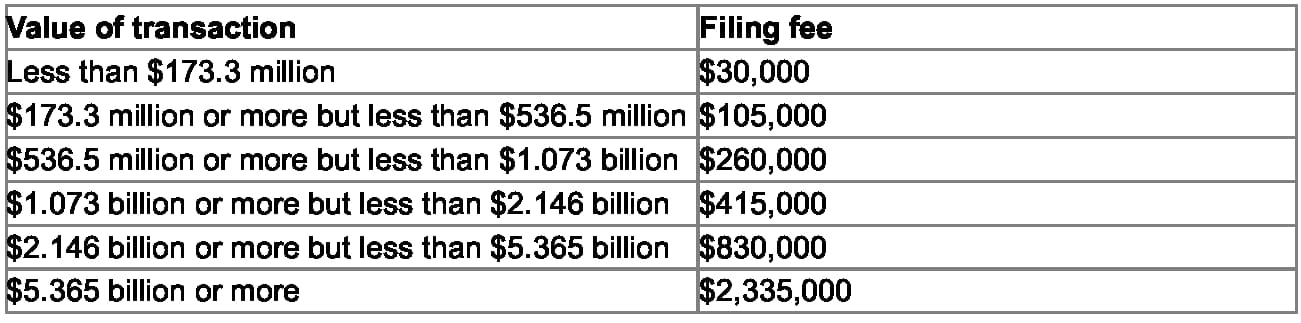
Filing fee thresholds
Additionally, the FTC approved changes to the HSR filing fee structure, which will become effective 30 days after publication in the Federal Register. For transactions that are imminent or currently underway, the applicable filing fee thresholds are those in effect at the time of filing notification.
Interlocking directorate thresholds
The FTC also recently announced revised thresholds that trigger prohibitions on certain interlocking memberships on competing corporate boards of directors. As of January 12, 2024, this prohibition does not apply if either competitor corporation has capital, surplus, and undivided profits totaling below $48,559,000, or if the competitive sales of either corporation are less than $4,855,900, among other exceptions.
Civil penalties
On January 11, 2024, the FTC announced that the maximum civil penalty amount for violations of the HSR Act and Section 5 of the FTC Act (prohibiting “unfair methods of competition”) will increase from $50,120 to $51,744 per day. The changes are effective as of the date of publication in the Federal Register (January 10, 2024).
Nonreportable and cleared transactions
While noncompliance with the HSR Act carries serious penalties, the fact that a transaction does not meet HSR filing thresholds or has already received HSR clearance to close does not mean that such a transaction is immune from scrutiny by antitrust enforcers. The Antitrust Division of the Department of Justice and the FTC have previously filed suits seeking to unwind consummated mergers, including mergers that had received clearance following antitrust review. Enforcers have also challenged transactions well below the threshold for the size-of-transaction test, including those with a purchase price of less than $10 million. Additionally, the FTC’s renewed interest in Section 5 of the FTC Act signals the agency’s intention to investigate nonreportable transactions (or a series of nonreportable transactions) that it views as constituting an “unfair method of competition.”
Given that the FTC has dramatically increased its enforcement of the antitrust laws in recent years, and the complexities and nuances in this particular area of the law, it is always wise to consult with experienced antitrust counsel regarding HSR filing obligations and substantive antitrust issues in connection with transactions of all sizes. To learn more about our experience, please contact any of the authors listed below or the Reed Smith lawyer with whom you regularly work.
Client Alert 2024-018
Authors